The Aural Apothecary Medicines Map 2025 - Infographic or Art?
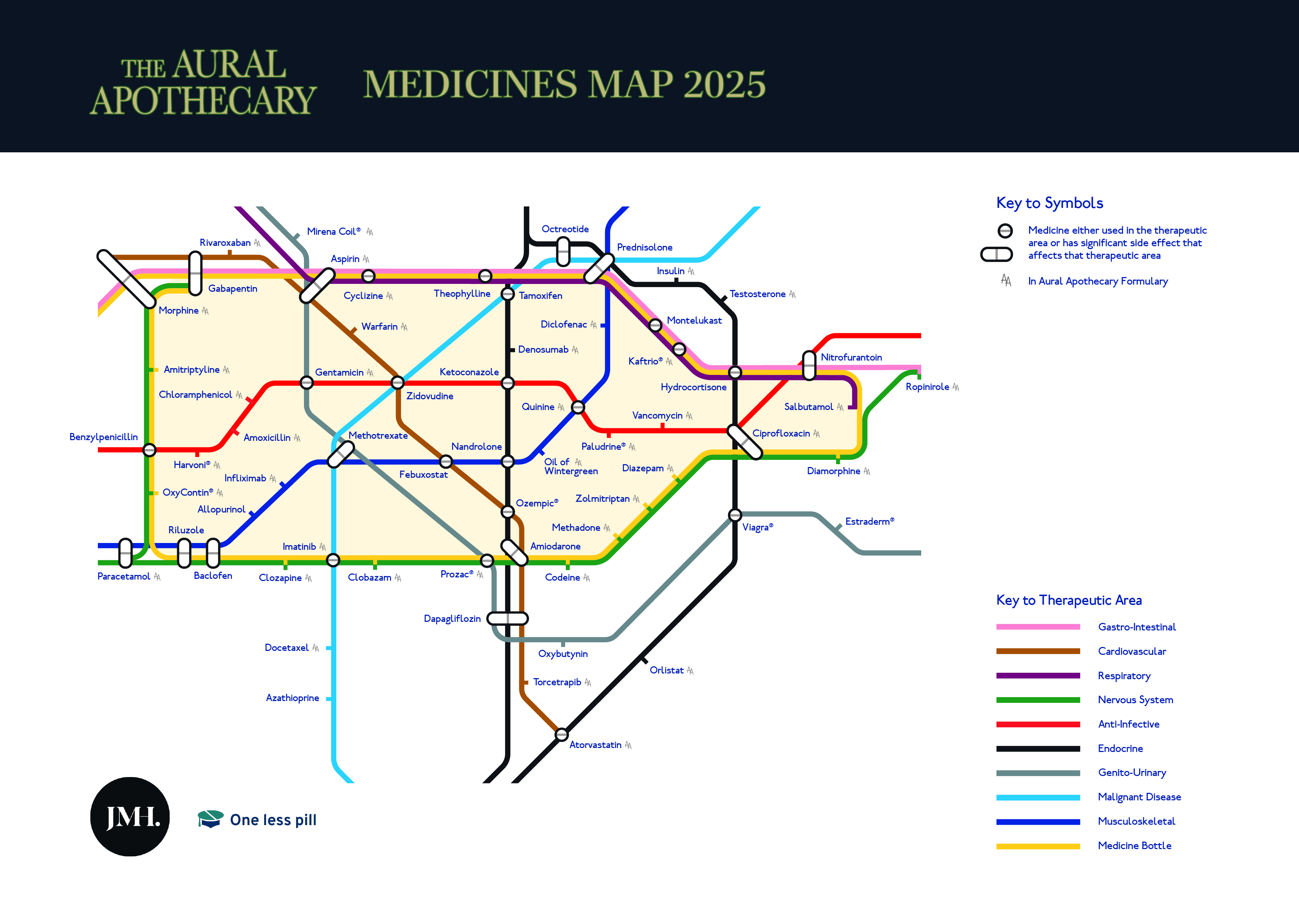
So, ever since the Aural Apothecary podcast started, Jamie had said how cool it would be to design a medicines version of the London Underground tube map. He said he would he thought it would be a great piece of art! He had mused about it for a while but didn't really know how to start. Asking AI had not been very fruitful, with it just listing random medicines from different therapeutic areas on different coloured lines. So just before we went to the EAHP conference in Copenhagen , in March this year, I started to give it some serious thought and, of course, was eager to prove that my human brain was better than AI!
For me it all started with the station interchanges and what seemed like a straightforward idea that each BNF chapter would represent one of the 9 main different coloured lines. For example, surely chapter 2 of the BNF, the cardiovascular section, would be the Central line because it was blood red, right? Wrong!
So, this was the tricky bit, how could you link the cardiovascular medicines used on the Central line where it had an interchange with another line, say the Northern line or the Bakerloo line, that each represented a different BNF chapter? Eventually I realised the best way to do this was to work on the principle that each medication that represented a different “station” on a given “line” , but which had an interchange with another “ line” would need to: either pharmacologically work in each therapeutic area e.g. Cyclizine is used as an antiemetic (BNF chapter 4 : Nervous system ) but is also an antihistamine (BNF chapter 3 : Respiratory) ; or cause an adverse drug effect in one therapeutic area e.g. Baclofen is used in spasticity (BNF chapter 10: Musculoskeletal) but commonly causes drowsiness and confusion under another therapeutic area (BNF chapter 4: Nervous system).
This meant that I had to start with the stations that had the most interchanges and work backwards, so King Cross station really was “King “as it had the most interchanges, five. This was actually an easy pick as Corticosteroids are used in multiple therapeutic areas but also has lots of significant side effects.
Therefore, on this map Prednisolone was to be the King's Cross.
The station with 4 interchanges, Baker St, also required a stellar choice, and that was Aspirin, Gimmo’s Desert Island Drug!
It was at this point that I then made the whole thing harder for myself by thinking what a great idea it would be if I could use as many medicines as possible that had been chosen by Aural Apothecary Alumni. These are all represented on the map with a little AA annotation.
I also realised how hard it was to include the Circle (yellow) line, with a whopping 25 stations in this map, within my interchange’s principle. My wife, who is a pharmacist, who generally has banned the “P” word within our house, came to my rescue. I had showed her an early iteration of the visual map and she said in passing, “can you see the medicine bottle within the heart of the circle line?” This turned out to be a game changer, and we exaggerated this idea in the final version, using subtle shading to ensure the bottle was obvious. Since we revealed the AA Medicines map at the Clinical Pharmacy Congress (CPC ) in London this year people have subsequently contacted us and told us that they cannot unsee the medicine bottle when they now look at a standard London Underground map. Further, in a conversation with somebody in a London hotel at a mental health charity event this year I was “amazed” to find out that Londoners have apparently been aware of this for a long time….
So back to the less than simple task of finding medicines that have multiple therapeutic uses I discovered that this venture was the worst, most fiendishly difficult, Sudoku puzzle you have ever done, with the equivalent of only 1 number in each block of 10!!! Where possible I tried to use iconic or game changing medicines and I thought lots of stations with 3 interchanges needed “big beasts” , and so often found myself having to use “dirty drugs”, with significant side effect profiles, to represent them.
Waterloo was Dapagliflozin
Paddington was Morphine
Edgware Rd was Gabapentin
Embankment was Amiodarone
I know you are wondering what Gimmo’s role was in this masterpiece. Well, he marvelled at it all but when I said I felt I needed to add the “key” to explain the station interchange principles, cleverly illustrating using tablets and capsules, he said that would make it more an infographic than art ….
You decide, and please enjoy the map whilst you can as we don’t want another cease-and-desist letter to add to the one from the BBC re Desert Island Drugs, but this time from Transport for London. So, if you find it here on the “Aural Apothecary Abstractions” webpage periodically do share it with people who you think might be interested in it but please do not post on social media…..
If Medicines are your world, then marvel at it , and also see this as “Exhibit A” to prove why humans will always trump AI…
Merry Christmas and Happy New Year
Steve the Chemist on behalf of the 3 Apothecaries

The Contented Clinician Podcast


